



Commissioning a bespoke trophy is a journey that blends creativity, craftsmanship, and careful project management. Whether you’re recognising corporate excellence, celebrating sporting achievement, or honouring community contributions, understanding the commissioning process helps you plan backwards from your event date, budget accurately, and avoid costly surprises.
At Veritas, we’ve guided clients through this process for over two decades — from elite sporting institutions to some of the world’s leading brands.
Use this straightforward and comprehensive guide on how to commission your own unique trophy or award, from briefing your original idea, to budgeting and timelines, and transparent pricing to using sustainable materials. This will help you understand exactly what to expect when creating an important piece which your recipients will treasure for a lifetime.

The Commissioning Process: 7 Steps from Brief to Delivery
Step 1 — Build the Brief
Every successful bespoke trophy starts with a clear and thorough client brief. It is important to outline the purpose of your award or trophy. Does it recognise a sporting victory, sales achievement or industry recognition? Who is the target audience? Does it need to be caught on camera or film, and what are the budget parameters?
In order to help us work with you to conceptualise and visualise your design it is crucial to gather and share your brand assets. These are all the visual components to help the group visually conceptualise the design and may include the vector files of your logo or crest. Any imagery should be in AI, EOS or SVG format. This is so our designers can manipulate the logo to increase or decrease them in size and still retain perfect clarity.
Another important element of your organisation’s DNA is colour. Your colour palette will have developed, maybe over decades, and it is important that the colours you have chosen, maybe over years for your business are reproduced accurately. Therefore, we will ask for the Pantone references for primary and maybe secondary colours.
A secret ingredient, which might help inspiration, is your company archive. What photos, crests or documents remain from the company or club’s past. What did it look like at the beginning. For example, Arsenal Football Club still features a cannon amongst it principal motifs taken from the origins of the football club in the original Woolwich Arsenal. Our new King His Majesty Charles III uses the Tudor crown as central to his crest.
Step 2 — Physical and Practical Considerations
When dotting the i’s and crossing the t’s, don’t forget important practical and physical considerations.
What are the maximum sizes of available display cases?
What is the weight of the trophy, and what will be the impact on transporting it around the world?
Some trophies travel in protective metal cases for protection, mounted on wheels with extendable handles for easy use in airports.
Step 3 — Budgeting for your Trophy and Awards
Our team want to align with your budget expectations and achieve the most impressive and unique design possible for the allotted sum available.
Important drivers to consider which impact on cost are, one off moulds and tooling costs, machining and finishing hours, engraving and personalisation, as well as materials. It’s important to have a brief conversation around these points to ensure that expectations are aligned. Materials used can be a major factor.
Do you want something in solid sterling silver where cost has to include the price per ounce of the metal?
Is there 18-carat gold involved in any part of your trophy, or would you prefer to use something plated utilising 2 – 3 microns of precious metal?
The cost differences are significant, and we want you to have the trophy you want for the budget you want.
Step 4 — Design Concepts and 3D Renders
Our designers typically work on 2 – 3 design routes for your trophy or award. We are hoping that you will place the work with Veritas, but there is no charge for this design work. It is free of charge as because it’s part of our pitch to you. We are confident that you will love our designs and Veritas will be your choice of manufacturer of your trophy. But if you don’t choose Veritas, that is fine and there is no obligation.
At this stage you will see sketches and visuals and even 3D CAD models to show you the design, scale, proportions and branding placements for your design, each one following a clear rationale outlined from your original brief.
Photorealistic renders help stakeholders visualise and understand how the finished piece will appear, and the different nuances created by the use of different materials. Brushed and polished metals, gold or ionic plated finishes, the incorporation of crystal with precious metals – all these options change the appearance and impact of an original design. Every single element can radically alter the feel and tone of a piece. Will the base of your trophy be in solid oak, piano black wood or coloured crystal. All these different considerations can be explored at this design concept stage.
Step 5 — Revisions and Design Approval
Our experience is that projects often have two rounds of design amendments. Typically, a client will take a week or two to consider designs, maybe consult colleagues or a committee and come back with requested amends. There may be the choice between 2 – 3 design routes of significant difference. The choice of materials may be altered, text layout may be changed or simply the design and size of an engraved logo.
Once this critical gate is passed, the client has chosen the vision of the trophy they want to receive. Its then up to Veritas to bring it to life in the agreed timeframe and approved budget. Once you have signed off and approved the project, the exciting work begins.
Step 6 — Manufacture and Production
Our craftsmen, engineers and factories now start to bring your designs to life. They are now working to precise technical drawings, which you have approved, working with both traditional silver–smithing techniques and the most modern and sophisticated processes.
For example, an exact replica of a traditional stags head or military cannon will still be painstakingly carved by hand to create a green wax mould before masters are taking for casting, whereas a Formula 1 race car may be 3D lasered to appear as a perfect replica, unique in every detail, in the middle of a clear crystalline block.
The team at Veritas will guide and advise every client towards the best method which balances quality, time – lines and budgets for their special commission.
Step 7 — Finishing, Personalisation and Quality Control
We work in a variety of materials to create the trophies and awards our clients want within the budget parameters practicable. Sterling silver and gold and silver – plate are traditionally popular choices, whilst we also work in modern contemporary finishes offered by carbon fibre and crystal.
Personalisation adds the final touches to your trophy or award. We offer diamond cut and laser engraving to decorate silver and metal items with logos, crests, text and recipients’ names. Crystal can be surface etched as well as 3D laser etched to create fully three-dimensional logos and images in the centre of crystal awards.
Every finished design is carefully inspected against a client’s approved and signed off proof. Our QC team checks dimensions, finishes, engraving accuracy (ensuring there are no embarrassing spelling mistakes!).
Each piece is then carefully packaged being mindful of the dangers of damage in transit.
Trophies and awards can be photographed in our own in-house studio, and we can provide suitable files for your records for use in print or social media.
Bespoke Commissions: Case Studies
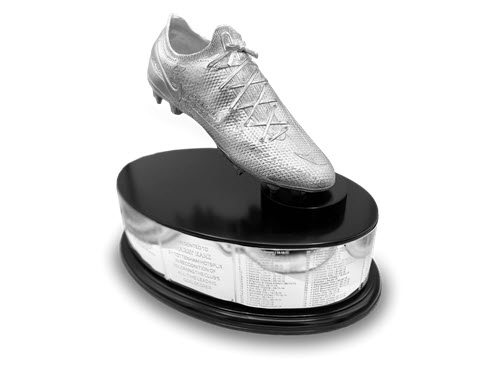
Harry Kane's Silver Boot
When Tottenham Hotspur striker Harry Kane broke Jimmy Greaves’ club goal-scoring record in 2023, the club commissioned one of our most recent sporting trophies to mark the occasion properly. Veritas had to manufacture a solid sterling silver boot; an exact replica of one of Kane’s own boots, weighing 4 kilos. Each of his 267 goals is individually engraved on the plinth, with the date and occasion. A small but personal detail we found was his children’s names are etched into the boot itself.
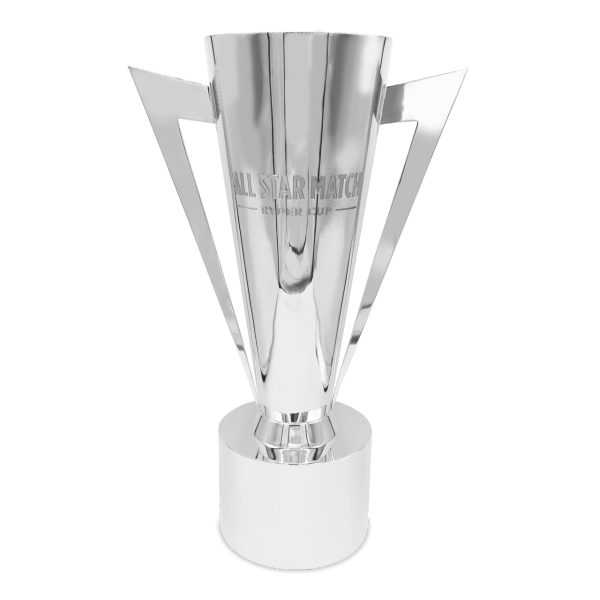
The Ryder Cup All Star Match trophy
For the 44th Ryder Cup at Marco Simone in Rome, we designed the trophy for the inaugural All Star Match. A competition involving professional players alongside celebrity amateurs including Gareth Bale, Novak Djokovic, and Victor Cruz.
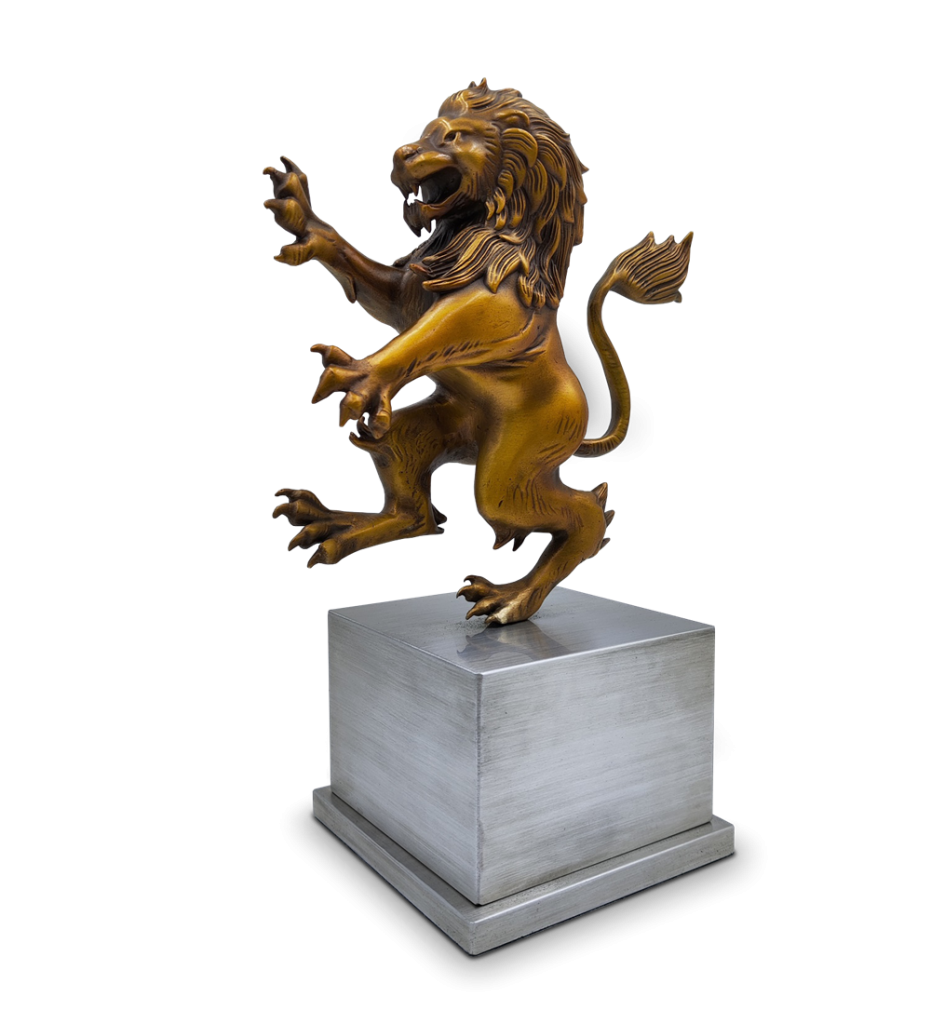
Aston Villa FC Match Day Gifts
Ahead of the club’s 2024 Champions League campaign, Aston Villa commissioned presentation gifts for opposition managers. The piece is a three-dimensional rampant lion, inspired by the club’s crest and the bronze statue outside Villa Park.
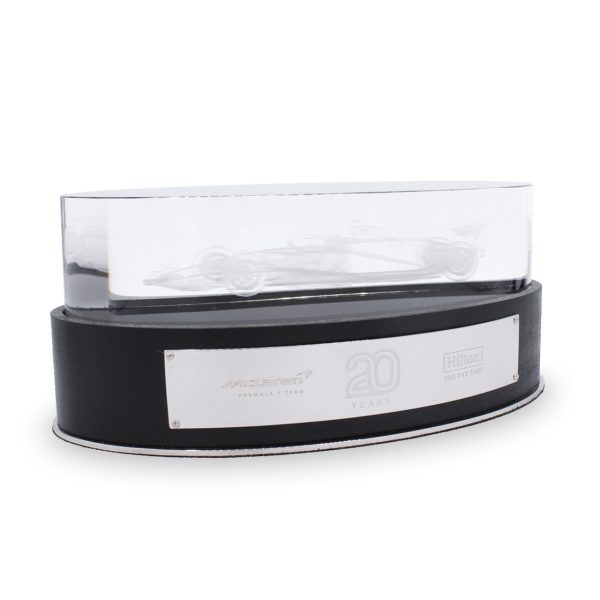
McLaren and Hilton 3D F1 Car Award
To mark twenty years of partnership between Hilton Hotels and McLaren, we produced an optical crystal block with a 3D-etched replica of the current McLaren Formula One car at its centre. The award was mounted on a wood plinth with a platinum-plated engraving plate.
IP, Licensing, and Replicas: Staying Compliant
Intellectual property compliance protects you from legal risk and respects creators’ rights. Here’s what you need to know:
When You Need Permission
Using third-party logos (sports leagues, brands, universities), mascots, character likenesses, or protected shapes requires written permission from the rights holder. Creating replicas of famous trophies — the FA Cup, Wimbledon plates — without authorisation infringes design rights and trademarks. Always secure licences before manufacturing begins; rights holders can halt production and demand destruction of infringing items. Budget for licensing fees, which vary from nominal to substantial depending on the property’s commercial value.
Ownership and Design Rights
Clarify who owns the final design intellectual property. Most contracts grant you ownership, but confirm this in writing — you may want to reproduce the design with a different supplier in future or create derivative versions. Understand the difference between a licence (the supplier retains ownership; you have permission to use) and assignment (you own it outright). Procurement teams in larger organisations typically require full assignment of IP to avoid future complications.
Brand Compliance Checklist
Maintain brand integrity by specifying Pantone colours precisely, respecting clear space around logos (typically equal to the logo’s height), confirming etch depths don’t distort fine details, and understanding finish limits (some plating processes can’t achieve certain colours). Keep a proof sign-off trail: dated emails or signed approval forms create an audit record if brand guardians later question compliance. This documentation protects both you and us.
Tip: If you’re uncertain about permissions, consult your legal team or the rights holder’s licensing department early. Discovering an IP issue after manufacture is expensive and embarrassing.
Sustainability and Ethical Sourcing
Our clients and their recipients increasingly value sustainability. And so do we!
Veritas is a fully signed up member of Planet Mark’s journey to Net Zero. Planet Mark works in conjunction with the Royal Warrant Holders Association to help both small and large business both quantify their carbon footprint and actively work to continually improve it further.
We are also mindful of the ethical sourcing and use of materials from ethically sourced precious metals to FSC-certified wood for bases and plinths which ensures timber comes from responsibly managed forests. We choose recycled metals where possible and work with fabricators offering recycled aluminium and brass that perform identically to virgin materials. For crystal and glass, ask about recycled content; some suppliers achieve 30–50% recycled glass without compromising clarity.
We’re happy to discuss packaging alternatives — recyclable or biodegradable materials in place of polystyrene wherever possible. Some commissions can also be delivered with carbon-offset options.
We comply with Modern Slavery Act reporting requirements and take supply chain responsibility seriously. The majority of the core factories we use are personally visited for our own assurance and that of our clients that our products are made in amicable fair, and equitable conditions.
Frequently Asked Questions
How long does it take to design and make a bespoke trophy?
The full process — from initial brief to finished piece — typically takes 12 to 16 weeks for a complex bespoke commission. Within that, allow around 3 to 4 weeks for the design phase (concepts, revisions, and final approval), up to 6 weeks for any origination work such as new moulds or tooling, and a further 6 weeks for manufacture, finishing, and quality control.
Simpler commissions in crystal or using existing forms can move faster. If you have a firm event date, share it with us at the first conversation and we’ll plan backwards from it.
How much does a bespoke trophy cost?
Cost depends on four main things: materials, tooling and mould origination, the number of finishing hours required, and any engraving or personalisation. Sterling silver commissions, for example, carry the cost of the metal itself priced by weight at the current silver spot price, which adds significantly to simpler plated or crystal alternatives.
We don’t publish fixed bespoke prices because every commission is different, but we’re straightforward about cost drivers from the first conversation. Once we understand your brief and budget, we’ll tell you honestly what’s achievable and where compromises might be necessary.
What materials can be used for a bespoke trophy?
We work in sterling silver, silver plate, gold plate, pewter, optical crystal, handmade glass, and carbon fibre, as well as combinations of these. Wood and crystal are commonly used for plinths and bases. The choice of material affects both the look of the finished piece and the manufacturing method — a stag’s head carved in wax and cast in sterling silver requires very different skills and time than a 3D-etched crystal block.
We’ll advise on the best material for your brief, taking into account your budget, the weight and transport requirements of the trophy, and how it will be displayed or photographed.
What do I need to provide to start a bespoke trophy commission?
A good brief covers: the purpose of the award, the recipient or recipients, the occasion and event date, any size or weight constraints, and your budget range. Beyond that, we’ll need your brand assets — vector files of your logo or crest in AI, EPS or SVG format, and Pantone references for your primary colours.
If you have anything from your organisation’s archive that might inform the design — historical imagery, old crests, photographs — it’s worth sharing. That kind of material often opens up the most distinctive design directions.
How many design concepts will I see before manufacture begins?
We typically develop 2 to 3 design routes for your consideration, each following a clear rationale drawn from your brief. You’ll see sketches and visuals, and for more complex pieces, photorealistic 3D CAD renders that show scale, proportions, material finishes, and branding placement.
This design work is provided free of charge as part of our proposal. Most projects go through two rounds of amendments before final sign-off.
Can you incorporate my company logo or crest into a bespoke trophy design?
Yes. Logo and crest integration is standard on most of our bespoke commissions. We’ll work from your vector artwork to ensure it scales correctly and reproduces cleanly in the chosen material — whether that’s engraved into silver, surface-etched into crystal, or applied as a raised relief.
If you’re working to brand guidelines, share them early. We check brand compliance as part of our sign-off process, including colour accuracy, clear space, and etch depth, and we keep a full approval trail throughout.
What's the difference between a bespoke trophy and a standard trophy?
A standard trophy is selected from a catalogue, engraved, and dispatched. It’s quick, predictable in cost, and perfectly appropriate for many occasions.
A bespoke trophy is designed from scratch to a specific brief. The form, materials, and every detail reflect the occasion, the organisation, and the recipient. It can incorporate custom reliefs, three-dimensional sculpted elements, unique shapes, and personalisation that goes far beyond text engraving. The Harry Kane silver boot we made for Tottenham Hotspur — a 4-kilo sterling silver replica of the player’s own boot, engraved with each of his 267 goals — is a trophy that couldn’t have come from a catalogue.
Do you need permission to replicate a famous trophy design?
Yes. Creating a replica of a protected design — the FA Cup, the Ashes urn, the Wimbledon plates — without authorisation infringes both design rights and trademarks. Rights holders can stop production and require destruction of infringing items, so it’s important to secure the necessary licences before manufacture begins.
If you’re commissioning a replica of an existing trophy or incorporating third-party intellectual property, tell us at the brief stage. We can help you identify what permissions are needed, and we won’t proceed without confirmation that the rights have been cleared.
Do you need permission to replicate a famous trophy design?
Yes. Creating a replica of a protected design — the FA Cup, the Ashes urn, the Wimbledon plates — without authorisation infringes both design rights and trademarks. Rights holders can stop production and require destruction of infringing items, so it’s important to secure the necessary licences before manufacture begins.
If you’re commissioning a replica of an existing trophy or incorporating third-party intellectual property, tell us at the brief stage. We can help you identify what permissions are needed, and we won’t proceed without confirmation that the rights have been cleared.
Can bespoke trophies be made from sustainable or recycled materials?
Yes, and it’s something we take seriously. Veritas is a member of Planet Mark’s journey to Net Zero and works with suppliers who offer recycled metals, FSC-certified wood for bases and plinths, and recyclable packaging wherever possible. Some crystal and glass suppliers achieve 30 to 50 per cent recycled content without any loss of clarity.
If sustainability is a priority for your commission, let us know at the briefing stage and we’ll identify the best options across materials, packaging, and delivery.
Can you make a single one-off trophy, or is there a minimum order?
We regularly produce one-off commissions. There’s no minimum order quantity for bespoke work. Single pieces are typically more cost-intensive per unit because tooling and origination costs aren’t spread across multiple items, but one-off commissions are at the heart of what we do.
If you need multiple identical pieces — say, for a rolling annual awards programme — economies of scale apply, particularly on any mould or tooling costs.
Can you make a single one-off trophy, or is there a minimum order?
We regularly produce one-off commissions. There’s no minimum order quantity for bespoke work. Single pieces are typically more cost-intensive per unit because tooling and origination costs aren’t spread across multiple items, but one-off commissions are at the heart of what we do.
If you need multiple identical pieces — say, for a rolling annual awards programme — economies of scale apply, particularly on any mould or tooling costs.
Do you handle engraving and personalisation?
Yes. All pieces can be engraved with names, dates, dedications, logos, and crest artwork. We offer both hand engraving and laser engraving depending on the material and the level of detail required. Crystal can be surface-etched or 3D laser-etched to create fully three-dimensional images within the piece itself.
Engraving is checked against your approved proof as part of our quality control process before despatch.
What happens if I need a trophy made to a tight deadline?
Talk to us. We can’t always accommodate very short lead times for complex silversmithing work, but we’ll tell you quickly and honestly what’s possible. Crystal awards and laser-etched pieces can often move significantly faster than cast and hand-finished metalwork.
If the deadline is fixed and the brief is complex, we may suggest a material or approach that delivers the same impact in a shorter timeframe, and we’ll be clear about the trade-offs.
Who owns the design once the trophy has been made?
In most cases, full ownership of the design is transferred to the client on completion. We recommend confirming this in your commission agreement before work begins — particularly if you anticipate wanting to reproduce the design in future or with a different supplier.
We’re happy to discuss IP assignment as part of the initial contract, and for larger commissions we’d always encourage both parties to have this confirmed in writing.
Planning Your Bespoke Trophy Commission
Commissioning a bespoke trophy with Veritas is a structured, transparent and inclusive process when you understand the steps, timelines, and cost drivers.
Start with a comprehensive brief that captures your vision, budget, and deadline.
Choose your manufacturing method based on the balance of quality, speed, and cost that suits your project — crystal awards and design with 3D lasering offer a fast turnaround, casting and silver-smithing for complex detail for traditional sculptural pieces.
Work backwards from your event date, allowing 3 – 4 weeks for design, up to 6 weeks for important moulds and origination and a further 6 weeks for manufacture and finishing. Using this guide your trophy design should develop seamlessly from first visuals and sketches to beautifully finished 3-dimensional work of art.
Outstanding achievement deserves an outstanding creation, something unique and something that will last a lifetime and beyond. With careful planning and a clear brief, we’ll create an award your recipients will treasure, a tangible symbol of achievement that reflects the full prestige of the recognition it represents.
Whether you’re honouring a single lifetime milestone or recognising team members across an annual programme even creating a world-class sporting trophy we can ensure your commission arrives on time, on budget, and beyond expectations.
For more information, to request a quote, or to discuss a bespoke commission, contact our team on +44 (0)1483 281 417 or email sales@veritasgifts.co.uk.
enquire about a bespoke trophy


